Double Chin Treatments: How to Reduce Fat Under Your Chin
Search “double chin treatments” and you’ll get the same list every time: injectables, cooling devices, chin straps, jaw exercises, surgery. What none of those lists tell you is the one thing that actually determines your result—what’s causing the fullness under your chin in the first place.
Fat, loose skin, and a recessed jaw each call for a different category of treatment. Once you know which one you’re dealing with, a defined jawline is often within reach without surgery.
The Issue: Is It Fat, Loose Skin, or Your Jaw Structure?
Before looking at treatment, it helps to know what a provider looks for, because the same visual concern has three different underlying causes.
Fat tends to feel soft and pinchable. If you can gently gather the tissue under your chin between two fingers and it feels like a distinct pad, that’s likely fat. This is the presentation Kybella was designed for.
Skin laxity feels different. The tissue is thinner, doesn’t pinch into a substantial pad, and may look slack rather than full. Fat-reduction treatments target fat rather than skin elasticity, so they’re not the answer for laxity on their own. Non-surgical skin tightening is what does address it.
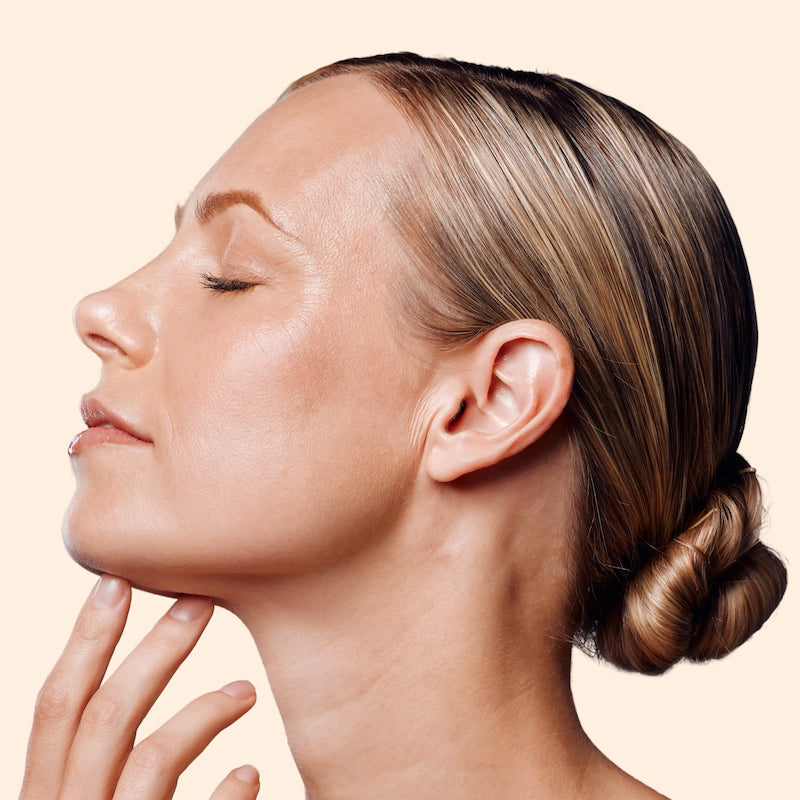
Structure is the third possibility. If your chin sits further back relative to your lips and forehead in profile, what you’re seeing may be projection rather than volume under the jaw.
These often overlap, and a provider settles it by hand. Use this to know what to ask about at your consultation.
When Filler Is the Better Fit
If a softer jawline is what you’re noticing, the answer may sit in a different category. Adding definition along the jaw and chin is what facial balancing addresses, using filler to build structure rather than reducing fat. It’s a different treatment aimed at a different goal, worth knowing before treatment.
Why Submental Fat Doesn’t Respond to Weight Loss
Submental fat often does not reduce with the rest of the body. People lose meaningful weight, keep it off, stay active, and still see the same fullness under the chin.
That isn’t a failure of effort. Where your body stores fat is largely determined by genetics, and fat loss can’t be aimed at a specific spot, which is why no amount of targeted work changes this particular area.
Anatomy explains the rest. The fat under your chin sits in layers separated by the platysma, a thin sheet of muscle across the front of the neck. Some of that fat sits above the muscle and some below it, and that distinction matters because only the fat above the platysma can be treated without surgery. When someone has a meaningful amount of deeper fat, non-surgical treatment can improve the contour but won’t reach everything, and knowing that in advance is what keeps expectations realistic.
In the American Society for Dermatologic Surgery’s 2019 Consumer Survey, 73% of consumers named excess fat under the chin as a top aesthetic concern.
What Actually Reduces Fat Under the Chin
Once you know fat is what you’re dealing with, the field narrows quickly. Creams, straps, and chin exercises don’t reach the fat at all, so they’re out regardless of how they’re marketed.
That leaves three routes that do something. An injectable breaks the fat down and lets your body clear it. A cooling device chills it. Surgery removes it and reaches the deepest fat, though it asks the most of you in recovery.
OVME’s route is the injectable. Kybella® is FDA-approved for this exact area, and the rest of this article covers what it does, what the evidence behind it shows, and how to tell whether it fits.
How Kybella Works
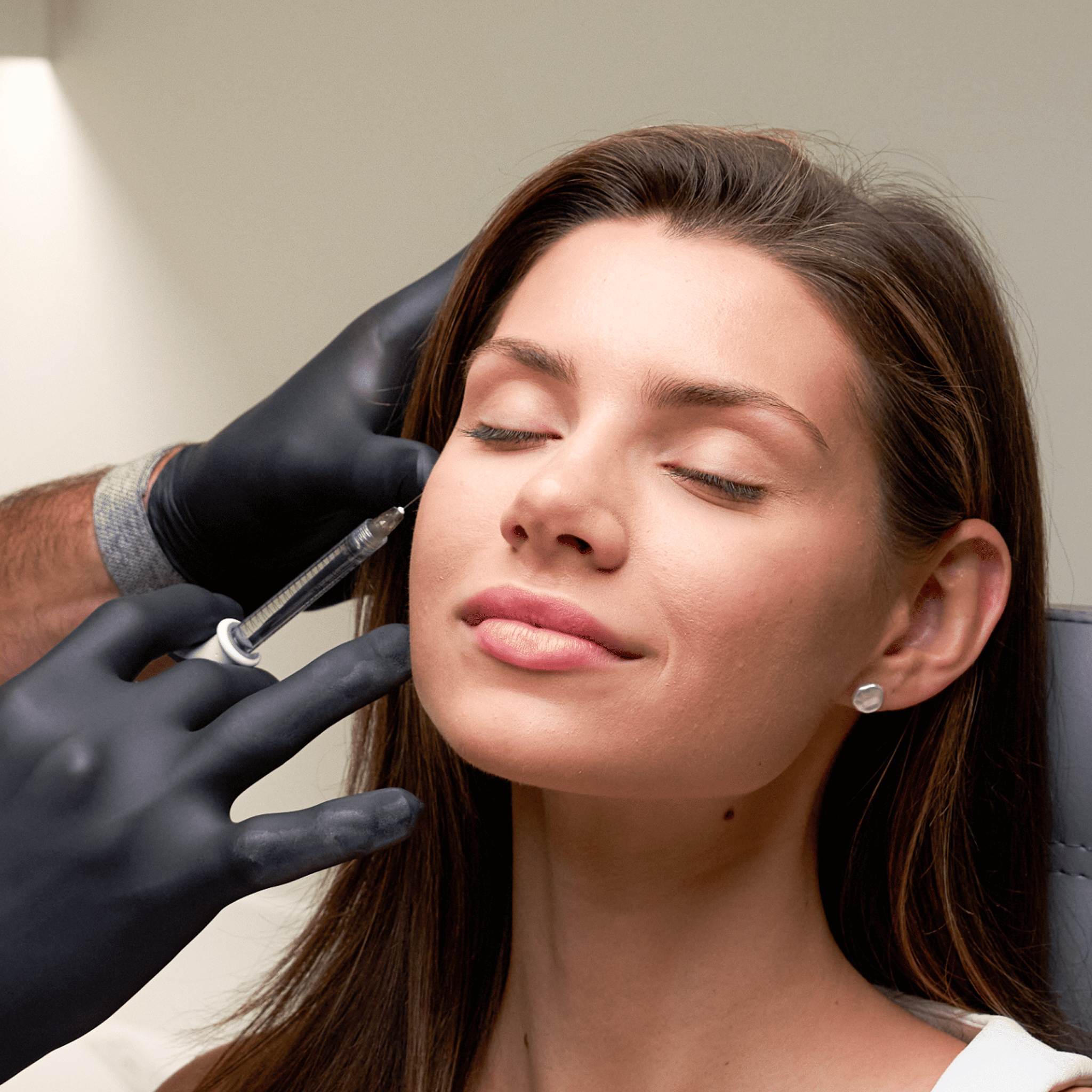
Deoxycholic acid is a substance your body already produces to help absorb dietary fat. Kybella at OVME uses a synthetic form of it, and once the fat cells in the treated area are broken down, the body clears them gradually over the following weeks.
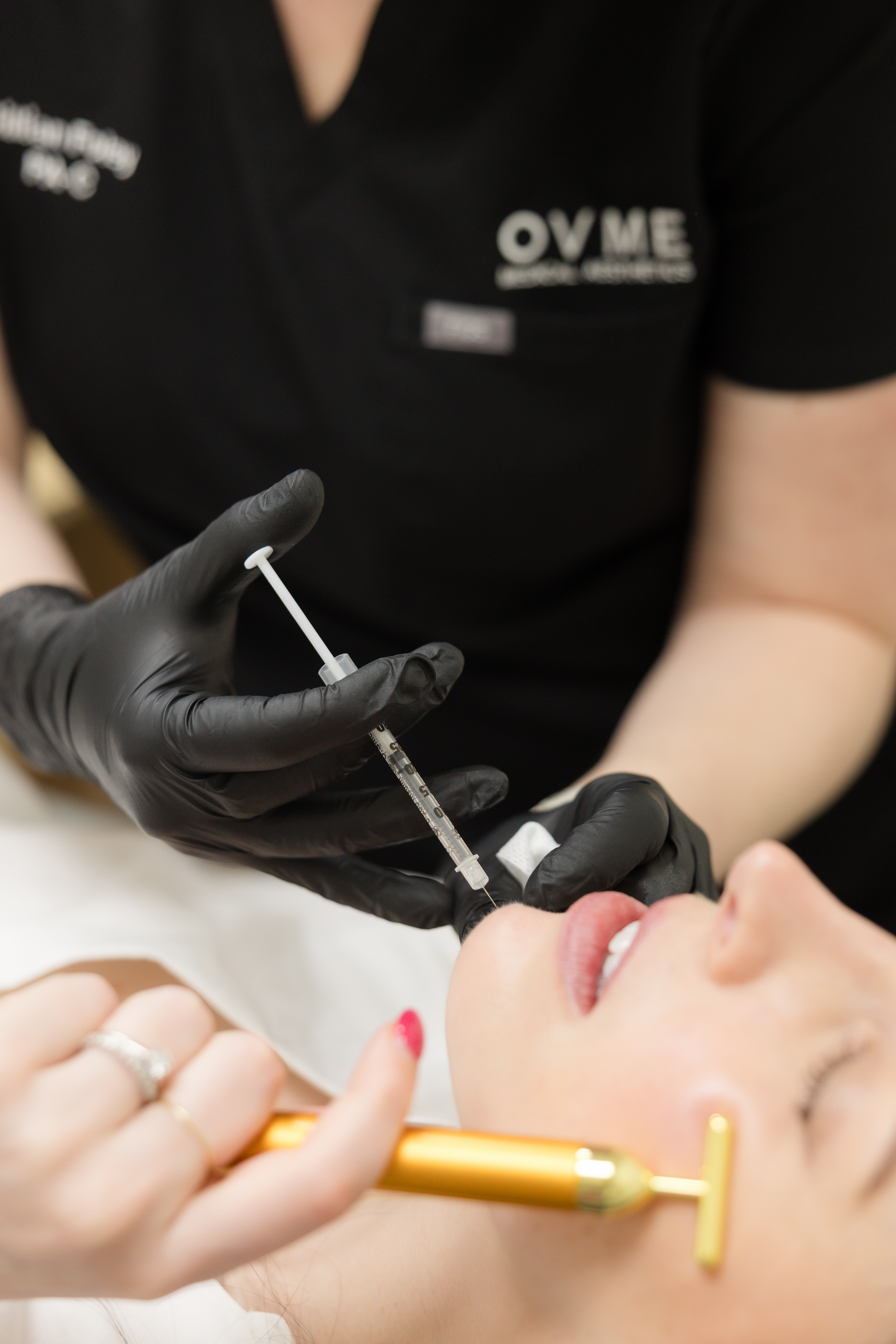
The FDA-approved indication is improvement in the appearance of moderate to severe convexity or fullness associated with submental fat in adults. A session involves a grid of small injections across the area, with the number depending on how much fullness is present.
Because the fat cells are cleared rather than displaced, the change holds without maintenance treatment once you reach the result you wanted. That’s the part people find most reassuring: you’re treating toward an endpoint rather than signing up for something indefinite.
Results build gradually. The body needs time to clear the treated fat, so the change emerges over weeks, and you’re assessing your result between sessions rather than immediately after one.
What the Evidence Shows
Kybella’s submental data comes from phase III randomized trials. In the REFINE-2 trial, 66.5% of patients treated with deoxycholic acid achieved a composite improvement on both clinician and patient submental fat rating scales at 12 weeks, compared with 22.2% on placebo.
Follow-up matters more than the twelve-week number, because it speaks to whether the result lasts. Clinician-reported response held at 82.4% at the three-year mark, against 65.0% in the comparison group.
How It Compares to the Other Options
Kybella sits between doing nothing and having surgery, and that’s the useful way to place it.
Against creams, straps, and chin exercises, there’s no contest. None of them has been shown to reduce submental fat, because none of them reaches the fat at all.
Against surgery, neck liposuction and neck lift procedures reach the deeper fat below the platysma that no injectable can, so for significant volume they remain the more complete answer. What Kybella offers instead is a treatment with no incisions, no general anesthesia, and no surgical recovery. If you’re weighing non-surgical against surgical options more broadly, injectables versus surgery walks through it.
Against device-based fat reduction, the difference worth knowing is the depth of the evidence in this specific area. Kybella’s submental results come from large phase III randomized trials; the published studies for cooling devices under the chin are considerably smaller. Kybella is also injectable rather than applied through a fixed applicator, so a provider places it according to where the fat actually sits.
Against skin-tightening treatments, it isn’t a comparison so much as a different target. Those address laxity; Kybella addresses fat. If loose skin is the main contributor to what you’re seeing, fat reduction is not the treatment you need.
How Many Sessions You’ll Need
FDA labeling allows up to 6 single treatments, administered at intervals of no less than one month apart. Most people don’t need the maximum. The number depends on how much submental fat is present and what you’re aiming for, and your provider builds that plan rather than applying a fixed schedule.
Kybella isn’t a single-visit proposition, and it builds gradually rather than delivering a visible change the same week. Planning for a sequence from the start is a better experience than expecting one appointment to finish the job.
What Recovery Looks Like, Day by Day
Swelling is the expected response. It’s often significant and most pronounced in the first few days. Pooled data from the pivotal trials listed swelling in the large majority of patients, along with bruising, pain at the injection site, numbness, redness, and firmness. These are common and temporary, and they resolve as the area settles.
The practical implication is scheduling: plan treatment when you have a few low-visibility days rather than the week of an event. What to expect during Kybella recovery covers preparation and aftercare in detail.
Swelling settles in days. The contour change keeps developing for weeks after that.
How a Provider Decides Which Treatment You Need
Assessing this area is harder than it looks, because the causes overlap and the tissue sits in layers you can’t evaluate by eye alone.
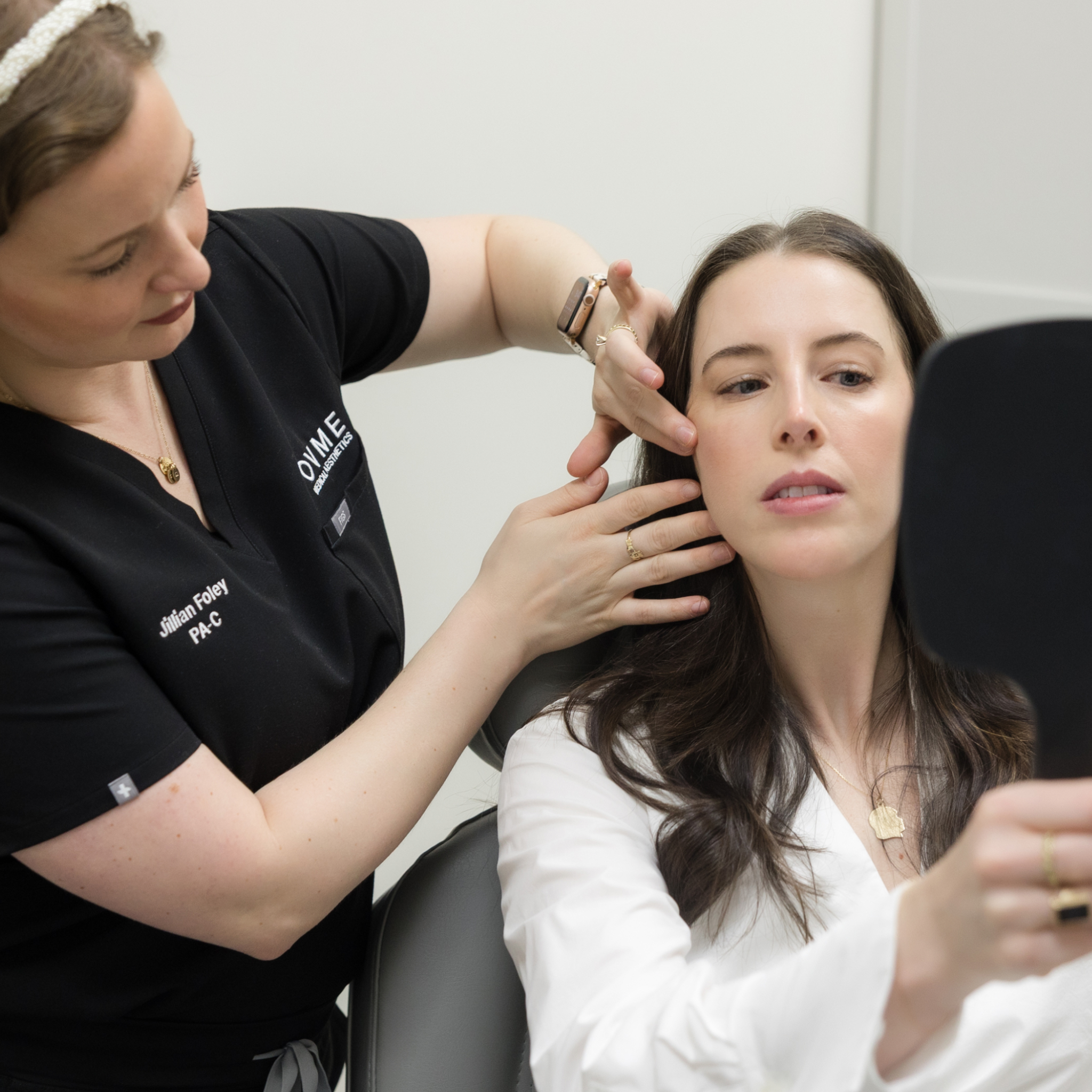
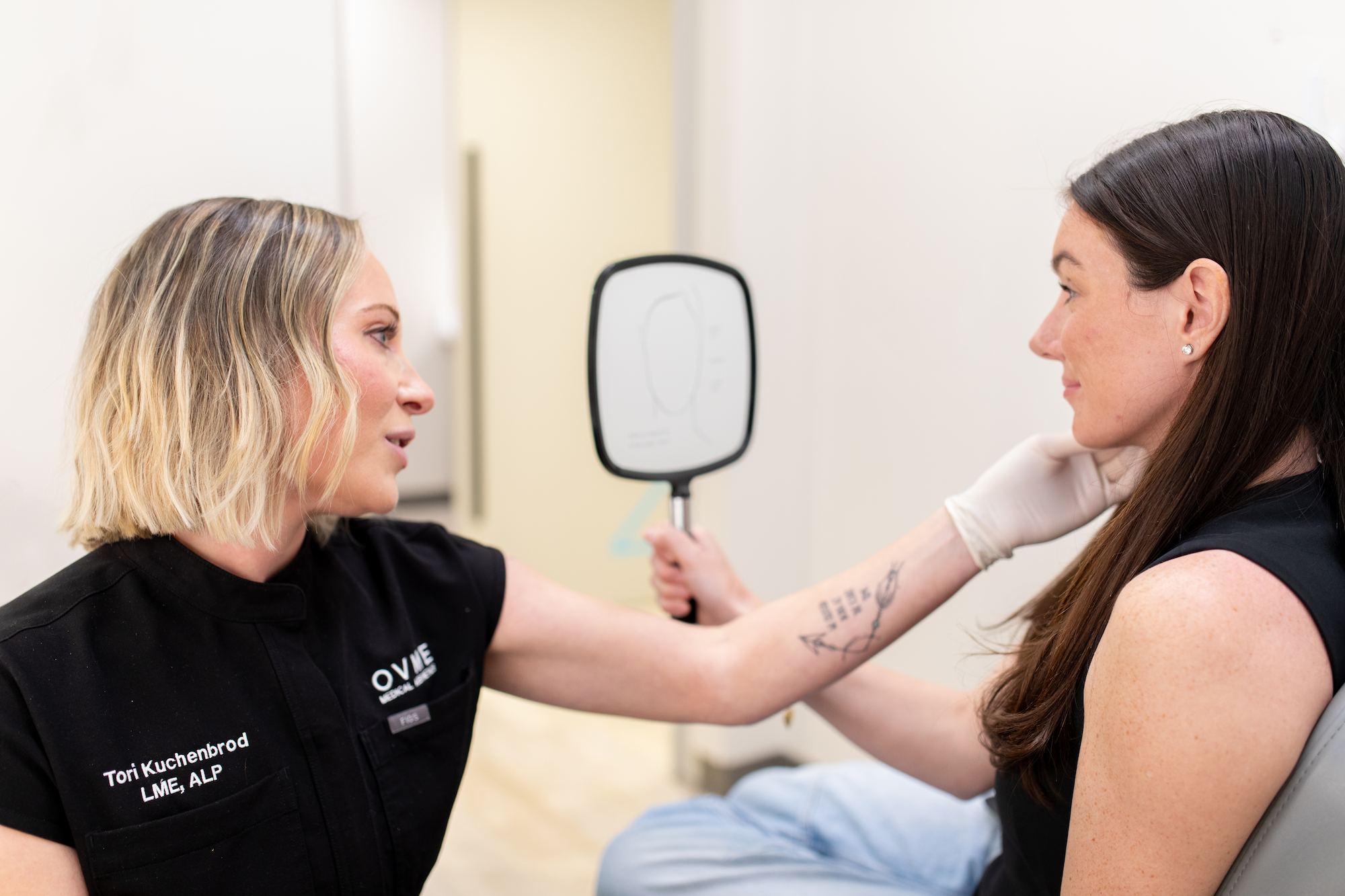
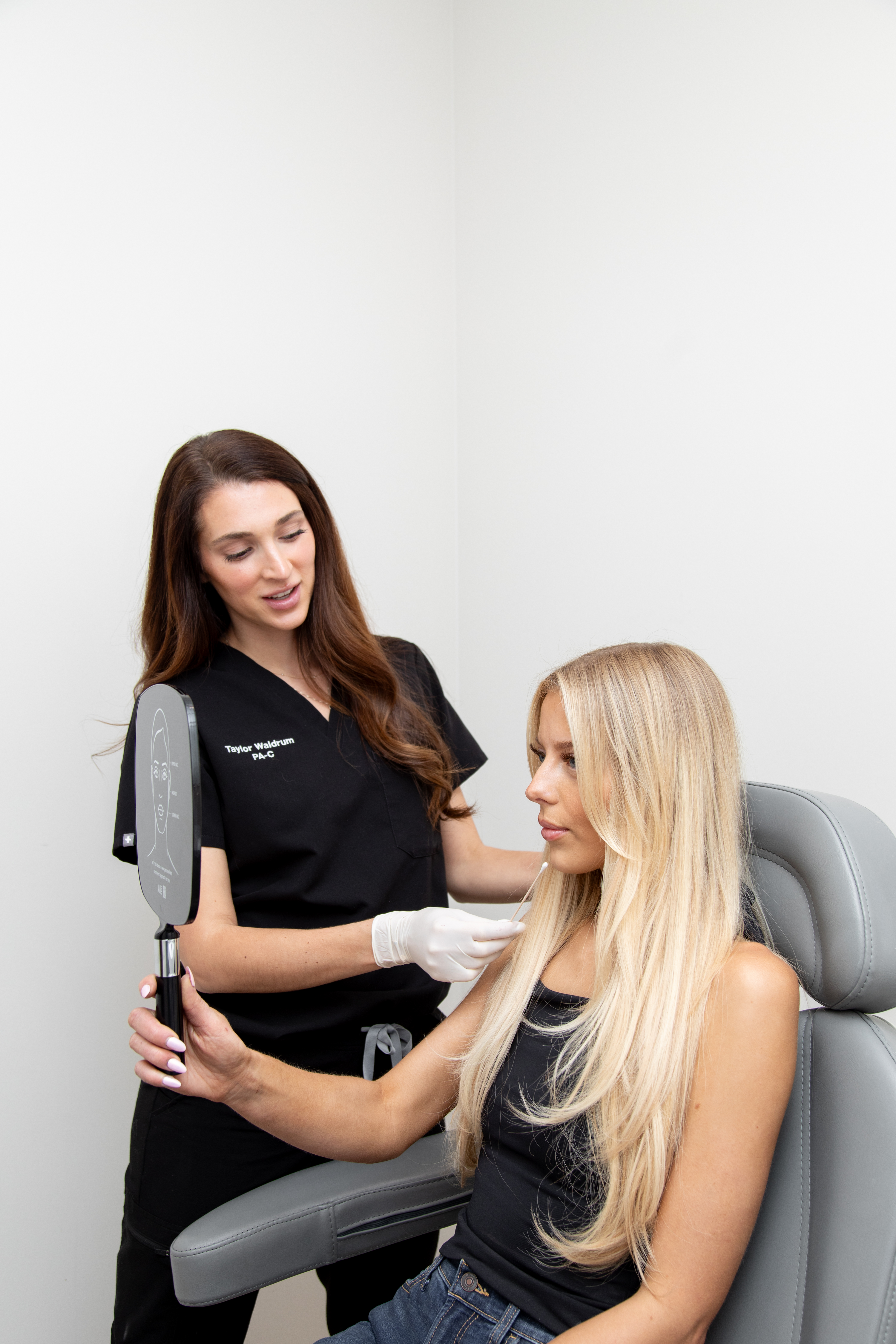
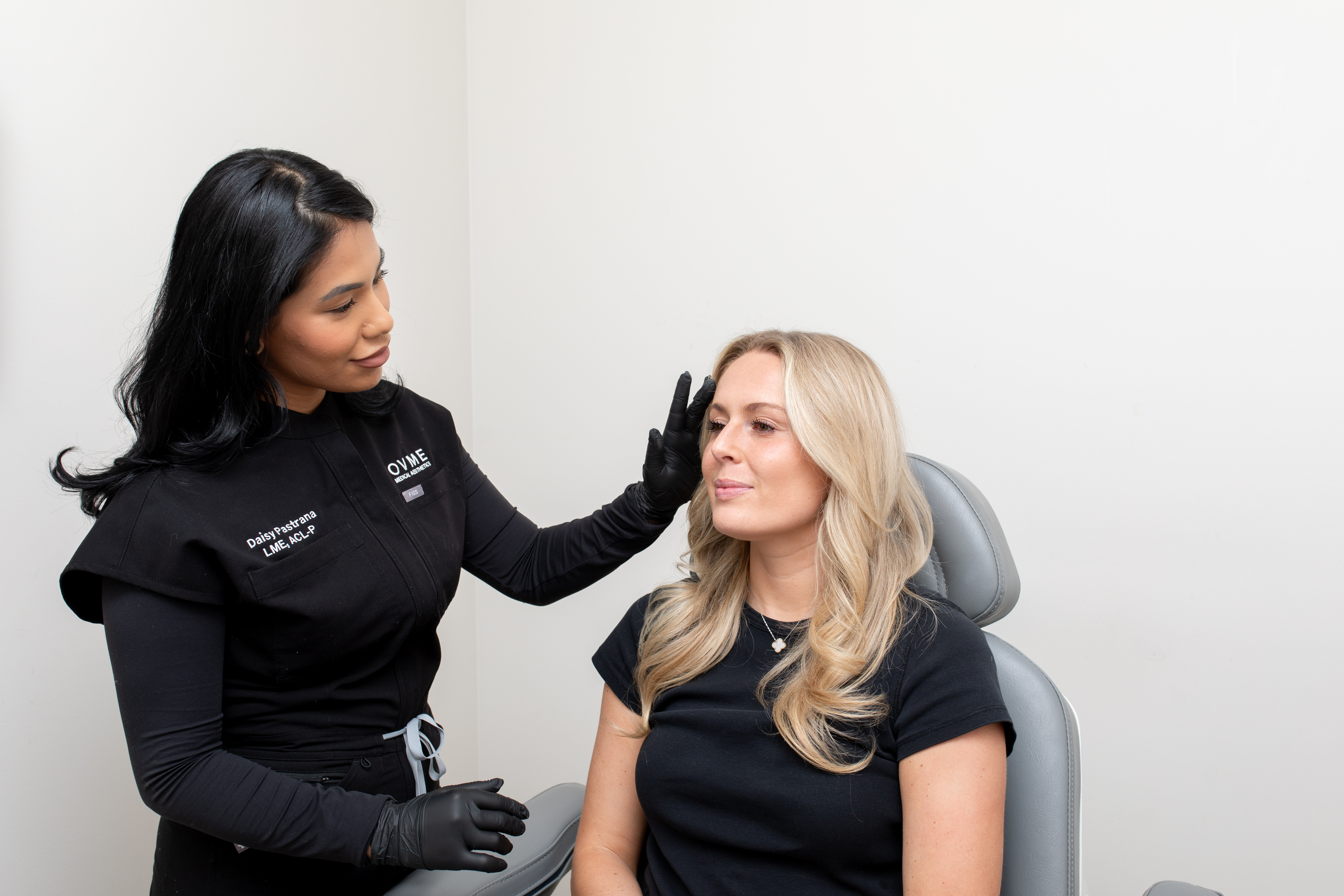
At OVME, that assessment starts in person. A complimentary consultation includes a hands-on evaluation of how the tissue under your chin behaves. Whether it pinches as a distinct pad or reads as laxity is what separates a fat concern from a skin concern. VISIA® imaging skin analysis is available at in-studio consultations to document skin texture, pigmentation, and sun damage across the face, though the submental assessment itself is done by hand.
Your provider then tells you which treatment your anatomy calls for and why, Kybella included, along with a realistic session count and what recovery will look like. If fat isn’t the main thing driving what you’re seeing, you’ll hear that too, along with what would address it instead.
Deciding Your Next Step
One appointment tells you what’s causing the fullness under your chin.
You’ll leave knowing whether fat, skin laxity, or structure is the main factor, whether Kybella fits, and roughly how many sessions to plan for. Session-based treatment pricing is confirmed at that consultation, before treatment. Consultations are available in-studio or virtually across OVME’s 28+ locations.
Frequently Asked Questions
Can chin exercises or creams get rid of a double chin?
No cream, chewing-gum routine, or chin strap has been shown to reduce submental fat. Chin and jaw exercises work the muscles beneath the fat, so they can strengthen the platysma, the thin sheet of muscle across the front of the neck, without changing the fat pad sitting above it. The non-surgical option with the strongest evidence in this area is Kybella, which is FDA-approved to reduce submental fat.
Kybella vs CoolSculpting: which is better for a double chin?
Both reduce fat under the chin without surgery, and they work in different ways. Kybella is an injectable that is FDA-approved to reduce submental fat, and its evidence in this specific area comes from large phase III randomized trials. CoolSculpting is a device that is FDA-cleared to treat visible fat bulges, and its published studies for the area under the chin are considerably smaller. Kybella is the option OVME offers, and a provider will tell you at your consultation whether your fullness is the kind it treats well.
Am I a good candidate for Kybella?
Good candidates usually have submental fullness driven mainly by fat rather than by significant loose skin, since Kybella works on fat. Your general health, your goals, and how much fat sits under the chin all factor in. An OVME provider evaluates your neck and jawline in person and tells you whether Kybella suits your anatomy or whether a different treatment fits better.
Is Kybella safe to use on the face and neck?
Kybella is FDA-approved for use in the submental area, and at OVME it is administered by registered nurses, nurse practitioners, and physician assistants, all supervised by medical directors who are board-certified plastic surgeons. Your consultation includes a review of your health history to confirm you are a good candidate. Because recovery and results vary between individuals, the process starts with a personalized evaluation.
How much does Kybella cost?
Cost depends on how many sessions your plan calls for, since Kybella is priced per session rather than as a flat fee. The amount of submental fat present is the main factor in how many sessions you need, which is why an in-person assessment gives the most accurate estimate. Current session-based pricing for your nearest studio is on OVME’s pricing page.
Where can I get Kybella in the US?
OVME offers Kybella for submental fat across 28+ studio locations throughout the United States. Every studio follows the same consultation-first approach, with a licensed provider assessing your anatomy before recommending a plan. You can find your nearest studio and book a complimentary consultation through OVME’s studio locations page.
Keep on reading